The Kastamonu Governor’s Office—A Stone Manifesto of the First National Architectural Movement
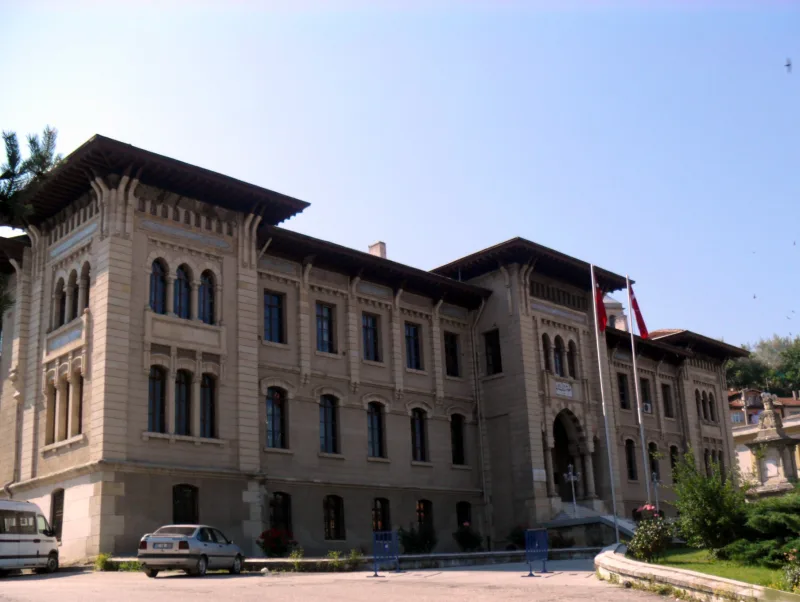
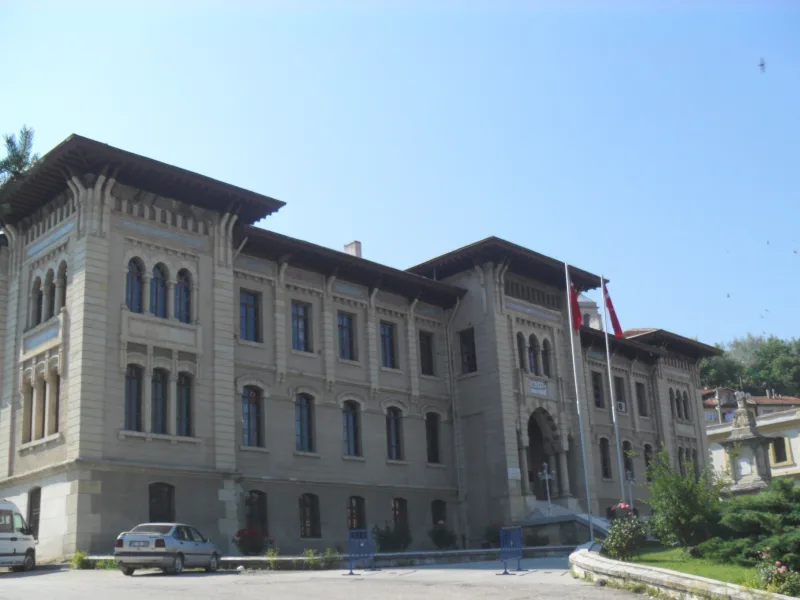
On the main square of Cumhuriyet (Cumhuriyet Meydanı) in Kastamonu stands a building that serves both as the current governor’s office and as a historical monument of national importance. The Kastamonu Governor’s Office (Kastamonu Hükûmet Konağı, “Kastamonu Government Konak”) is a three-story building made of hewn stone, opened on September 1, 1901, on the 25th anniversary of Sultan Abdulhamid II’s accession to the throne. The Kastamonu Governor’s Office was designed by architect Vedat Tek (1873–1942)—one of the founders of the First Turkish National Architectural Movement and the son of Syrra Pasha, the former governor of Kastamonu. In 2002, Turkey’s first museum of urban history, the Kastamonu City History Museum, opened on the ground floor of the building.
History and Origins of the Kastamonu Governor’s Office
The history of administration at this site dates back centuries. The first mentions of a konak (administrative building) in Kastamonu appear in 17th-century court records (şeriyye sicilleri). This building underwent several renovations and additions until it burned down in a fire in 1833. After the fire, a new wooden konak was erected, which stood until the turn of the 19th and 20th centuries, when its dilapidation became so evident that a decision was made to demolish it.
Vedat Tek, a young architect who had studied in Europe and was just beginning to formulate what would later be called Turkey’s “First National Architectural Movement,” was commissioned to design the new building. This movement sought to synthesize the Ottoman architectural tradition with European classical principles—and the Kastamonu konak became one of the first mature manifestations of this quest. Construction began in 1900 and was completed in 1901. The building’s opening was specifically timed to coincide with the 25th anniversary of Abdulhamid II’s reign—September 1, 1901—and was held as a grand provincial ceremony under the leadership of Governor Enis Pasha.
The family connection is telling: architect Vedat Tek was the son of Syrra Pasha, who had once served as the vali (governor) of Kastamonu. This made the project not merely an administrative commission, but a personal, even sentimental undertaking—a son designing a ceremonial building for the city where his father had ruled.
In 2015, the historic building underwent restoration. Today, it continues to function as the main administrative center of Kastamonu Province—a rare case where a historic building has not been turned into a museum but retains its original function a century and a half later.
Architecture and What to See
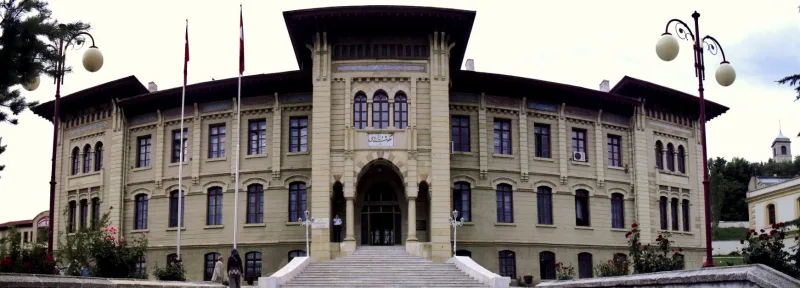
Kastamonu Hükûmet Konağı is a building where first impressions can be deceiving: from the outside, it looks like a austere European administrative palace, but take a closer look and you’ll see distinctive Eastern details integrated into the classical structure.
Layout and facade
The building is three stories tall (with a raised basement and two full upper floors) and rectangular in plan. The interior layout is classic for an administrative building: a wide corridor running the full length of the floor with rooms on both sides. The facade faces directly onto the city’s main square, Cumhuriyet Meydanı, completely dominating it. The architectural appearance follows the schemes of European official buildings of that time with academic rules—but Vedat Tek incorporated Ottoman identity into this scheme: distinctive arch forms, the treatment of the entrance arcade, and the proportions of the tower-like risalits.
Grand staircase and entrance portico
The main entrance is framed by an arcade with three arches: two smaller side arches and one central, pointed arch in the Ottoman style. A tall, monumental staircase spanning two stories leads to the entrance—a powerful architectural device. Vedat Tek transformed this ascent into a spatial event: what is called a podio (pedestal) in European architecture, he used not merely as a formal element but as a means to impart an unexpected monumentality to the building, despite its modest provincial scale. As you climb the steps, you literally feel the building’s stately grandeur—the same sensation one experiences upon entering certain pre-revolutionary Russian government offices.
Nighttime Illumination
At night, the building is fully illuminated by spotlights—the ceremonial lighting transforms it into an architectural focal point of the main square. The building looks particularly striking on foggy autumn evenings, when the light diffuses in the air and the white stone takes on a ghostly golden hue.
Museum of City History
Since 2002, the ground floor of the building has been occupied by the Kastamonu Kent Tarihi Müzesi—the Kastamonu City History Museum. This is the first museum of its kind in Turkey: it was created using documents, photographs, and artifacts collected by the city’s residents themselves with the support of the governor’s office. The exhibition includes historical maps, rare photographs, newspapers, and personal archives—everything needed to reconstruct the image of Kastamonu from its days as an Ottoman provincial center to the modern city. The museum is accessed through the building’s southwest entrance. A digital archive, available for academic research, operates nearby.
Interesting Facts and Legends
- The building’s opening on September 1, 1901, was specifically timed to coincide with the 25th anniversary of Abdulhamid II’s accession to the throne: the provincial konak became part of an empire-wide celebration.
- Architect Vedat Tek (1873–1942)—the son of Sirra Pasha, the former vali of Kastamonu—designed the konak for his father’s city; this lends the building a special biographical context.
- The Kastamonu City History Museum, which opened in 2002, is Turkey’s first municipal history museum of this kind: most of its exhibits are donations from citizens rather than state acquisitions.
- The building continues to function as an active governor’s office, making it a rare example of an early 20th-century historical structure that has continuously retained its original function.
- The nighttime illumination of the facade was added much later; Vedat Tek himself designed the building as daytime architecture—but the lighting proved to be a welcome addition, making the konak one of the symbols of Kastamonu at night.
How to get there
Kastamonu is located in the Black Sea region of Turkey, approximately 200 km east of Ankara. The nearest airport is Kastamonu (KFS), which serves domestic flights from Istanbul (about 1 hour 15 minutes). It takes about 15 minutes by taxi from the airport to the city center. An alternative is to fly to Ankara (ESB) and take a bus: the journey takes about 2.5–3 hours on a good road.
The Kastamonu Hükûmet Konağı building is located in the very center of Kastamonu, on Cumhuriyet Meydanı, at 10 Aralık Cad. 20/1, Cebrail neighborhood. From the bus station (otogar) to the center, it takes about 15 minutes by taxi or dolmuş. The museum on the ground floor is open on weekdays. The building itself is an active government office, so entry to the museum section is through a separate entrance on the southwest side.
Tips for travelers
Kastamonu is a cozy provincial town with well-preserved historic architecture that is little known to foreign tourists. In addition to the Governor’s Konak, the city center is home to Kastamonu Castle (a medieval fortress overlooking the city), the Nasrullah Mosque, and the wooden Ottoman houses in the neighborhoods near the bazaar. You can walk to all the key sights in a single day.
I recommend visiting the museum on the ground floor of the building on a weekday: it may be closed on weekends. It’s best to photograph the building’s facade in the evening when it’s lit up or in the morning when the sun illuminates the main facade. There’s little parking nearby, so it’s better to leave your car at city parking lots and walk—the center of Kastamonu is compact. The city has several cafes and restaurants serving local cuisine; a famous regional dish is Kastamonu pastırması (spiced dried meat) and local bread.
It’s convenient to combine a visit to Kastamonu with a trip to Inebolu (100 km north), home to the ruins of ancient Abonotich, and to Safranbolu (UNESCO, 150 km west) with its 17th–18th-century wooden houses. The Kastamonu Governor’s Office is a rare example of a building where the history of architecture, the history of the state, and the history of the city intertwine within a single structure that still functions as it originally did.